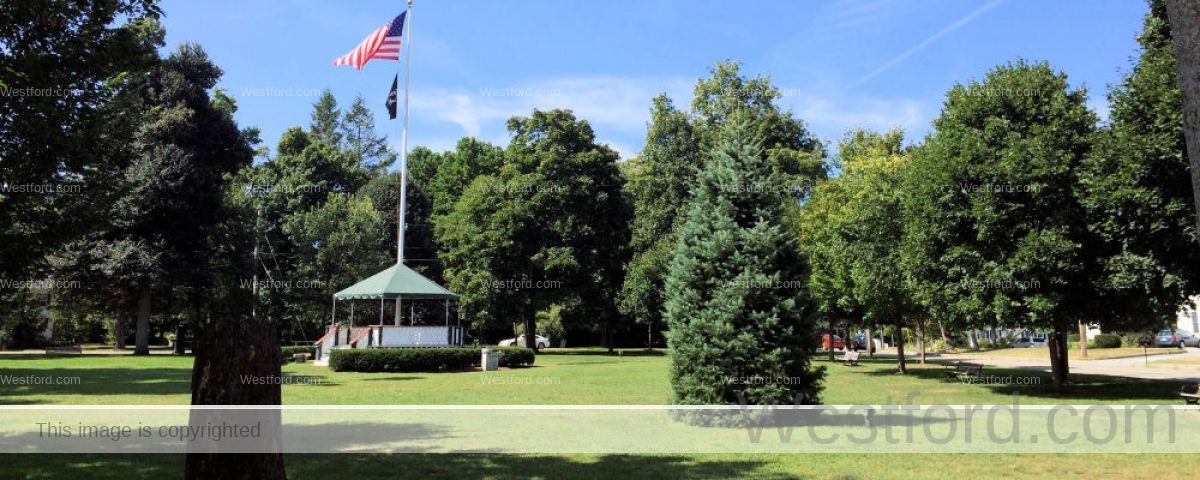
Westford’s Civil War Monument
A
Centennial History from Contemporaneous Sources
Copyright
2010 by the Westford Historical Society
2-4
Boston Road
Westford,
Massachusetts 01886
Memorial Day
2010 marks the centennial anniversary of the dedication of Westford’s Civil War
monument. That Memorial Day in 1910 was
a very significant and moving event in Westford’s history. Town buildings and houses were festooned with
bunting, flags were flown all over town, yards were freshly mowed, streets were
cleaned and groomed, and flowers were in bloom everywhere. The Nashua Military Band was on hand to
provide music and a concert. A large
tent was erected on the Common to house a catered dinner. People came from all over Westford, indeed
from all over eastern Massachusetts, to attend the momentous event. Orators included town officials, former
Governor and Secretary of the Navy John D. Long, and the generous benefactor of
the monument, Col. Edwin D. Metcalf, a former Westford resident then living in
Auburn, N.Y., who gave the monument in memory of his father and of all those
who served from Westford. Most
significantly, many veterans of the Civil War, now in their sixties and
seventies, were in attendance, proudly wearing their Grand Army of the Republic
medal and ribbon. It was a day long
remembered by all who were there.
The events of
the day were summarized in some detail in the 1911 Westford Town Reports. The local newspapers, The Westford Wardsman (a section of Ayer’s Turner’s Public Spirit) and The
Lowell Sun, also carried a number of articles leading up to the big day
and describing the event itself. Photographs
of the monument and of the event were prepared as souvenir postcards. In this booklet we have quoted those papers
and the town’s report of the “Dedication of Soldiers’ Monument and Memorial
Exercises, May 30, 1910” in their entirety, along with several photographs,
believing the contemporaneous reports provide the most poignant history of
the event. Col. Metcalf was also the benefactor in 1910
of several gifts to the First Parish Church in memory of his mother, including
the beautiful stained glass window behind the altar representing St. Elizabeth
leading a child through the path of life, and contemporaneous reports of those
gifts and their dedication are also provided.
The Westford
Wardsman, July 3, 1909
Center.
Capt. S. H. Fletcher has received a letter promising a monument to Civil
war veterans for the town from Col. Edwin D. Metcalf of Auburn, N.Y. He is son of William Metcalf, formerly of
this town, who served in the Civil war in Co. C, 16th Massachusetts Regiment as
first lieutenant, the only commissioned officer from this town. The proposed monument is a fine and striking
figure of a soldier.
The Westford
Wardsman, July 10, 1909
About Town.
Col. Edwin D. Metcalf of Auburn, N.Y., was in town Tuesday in
consultation with friends regarding the proposed soldiers’ monument. According to present plans the monument will
be dedicated next Memorial day. The
design has not been fully determined on, but will probably be of the “minute
man” style of design. It is proposed to
call an early meeting of interested citizens to discuss the matter of a
suitable site and other particulars.
Room permitting, the apex of the common would be the real showy
situation.
The Westford
Wardsman, July 17, 1909
Soldiers’ Monument.
There was a small but specially interested gathering of citizens at the
town hall last week Friday evening, to give a free expression of sentiment in
regard to the proposed soldiers’ monument.
Capt. S. H. Fletcher called the meeting to order and presided, and
stated the object of the meeting; a few important considerations have been
settled. First, there will be a monument;
second, it will be placed in position in the late autumn; third, it will be
dedicated on Memorial day, 1910; fourth, Ex-Gov. John D. Long will deliver the
address. All this, of course, is subject
to changes in the event of unforeseen contingencies. The two vital questions for the gathering on
Friday evening to express sentiment on were location and inscription. On the question of location, the sentiment of
the meeting was unanimous, with one exception, in favor of the land seized by
the county commissioners for highway purposes southwesterly of the common. The writer expresses the unsolicited opinion
of many, that for public view and harmony of surroundings, the intersection of
Lincoln and Main sts., rear of the Spanish cannon, the gift of Gov. Long, near
to the library and town hall, close view from the electric cars, is the ideal
place that can be defended against all other sites. The reply is not room. How is this—the common contains over an acre
of land, the triangular roadside site less than an eighth; remove three trees
at the apex of the common, lay out the plot for the monument with two curved
gravel walks each side of the monument, that center into one, then next year
when the common is improved with grading, walks and shrubbery, it will be an
ideal blending of the sacredness of the beautiful as well as the sacredness of
the monument. To place the monument on
the highway is giving the impression that there is an impractical sacredness
about the common. Howsoever, the writer
is not going to harbor a sulky disagreement on the question of location, and
this is the final expression private or public.
The Westford
Wardsman, July 24, 1909
The Soldiers’ Monument. Col. Edwin D. Metcalf has written a patriotic
letter to the selectmen, informing them of his intention to present to the town
a soldiers’ monument in memory of those who left their homes from 1861 to 1865
at the call of Abraham Lincoln; also in memory of the pleasant school days
passed by Col. Metcalf in Westford. It
is his desire to curb and grade the triangular lot suggested by Capt.
Fletcher. The monument is to be of
Barre, N.H. [Vt.], granite and the figure of a marching soldier to be of United
States standard bronze. It is expected
to be completed and in position this fall, and dedicated next Memorial
day. He appoints Capt. S. H. Fletcher to
act as his representative in consultation with the selectmen as representing
the town.
The selectmen
in reply to Col. Metcalf’s generous and patriotic offer, express the usual
abundant thanks and courtesies, and add, “It is most appropriate that your
native town should accept from so successful a son a soldiers’ monument, in
memory of those who fought in the war of the rebellion. Particularly is this so, in that your father
was the first citizen to volunteer in Westford and the only commissioned officer
from Westford in the war.” The selectmen
also express the hope that when he retires from active business, they will
again welcome him back to the home of his boyhood days. Col. Metcalf’s father, mother and brother rest
in Fairview cemetery, so that the associations of early boyhood days, and
school days and enlisting days and cemetery days all combine to make this
presentation by Col. Metcalf a memorial on many foundations. The patriotism of those who fought in the war,
and the patriotism of this gift should shadow and silence all dissension as
to location, inscription and details of procedure.
The Westford
Wardsman, July 31, 1909
Contract Let.
Col. Metcalf writes Capt. Fletcher that he has let the contract for the
new monument to the Harrison Granite Co., of New York city. The front of the monument will have the G.A.R.
badge and the numerals 1861-1865, and underneath, “Tribute to Westford volunteers
who knew no glory but their country’s good.”[1] On the other side will be inscribed,
“Presented to the town of Westford by Edwin D. Metcalf, of Auburn, N.Y., son of
Lieut. William Metcalf, Westford’s first volunteer, 1861.” In connection with the movement for this
monument the selectmen have got a timely, patriotic move on them, and held a
meeting Thursday evening, when the following citizens were appointed to act
with the selectmen in arranging the details for the erection and dedication of
this monument: Capt. S. H. Fletcher, George T. Day, Edward Fisher, Wesley O.
Hawkes, Julian A. Cameron. This
committee are eminently representative of progressive patriotism, and the power
of aesthetic influence, in their actions and by their environments. Behold the evidence, “By their fruits ye
shall know them.”
The Westford
Wardsman, September 18,
1909
About Town.
The committee on the soldiers’ monument, to be presented to the town by
Col. Metcalf, met last week Friday afternoon and laid out the ground for the
monument on the triangle opposite the common.
The land was surveyed by Melvin Smith of Lowell, who laid out the
grounds, plans for the grading and lines for the curbing. H. E. Fletcher & Co. furnish the curbing
from their quarry on Oak hill. H. W.
Tarbell of Lowell will place the foundation for the monument and grade the
lot. The committee are amply up to the
duty assigned them, and will push right along in time, tune and step with the
patriotism of this event.
The Westford
Wardsman, October 9,
1909
Center.
The work preparatory to the erection of the new soldiers’ monument,
which is to be presented to the town, is making good progress. The triangular piece of land at the west end
of the common where it is to be erected is being graded and built up, and a solid
foundation where the monument is to stand is being prepared and the triangle
finished with a substantial granite border.
The Westford
Wardsman, October 30,
1909
Center.
People in this village were obliged to do without the town water supply
Thursday from eight in the morning until four in the afternoon. This was necessary on account of relocating
the hydrant at the west end of the common, which was too near the triangle
where the new soldiers’ monument is to stand.
The Westford
Wardsman, March 5, 1910
Money for Town
Expenses. The financial committee have
completed their estimates of amounts of money necessary for town expenses for
the coming year. The writer has not seen
the report, but authority says the totals foot up $36,000, or $6,000 more than
last year. Among the recommendations by
the committee for raising money is $500 for the observance of Memorial
day. This day will be observed for the
dedication of the Soldiers’ monument, the gift of Col. Edwin D. Metcalf, a
former resident of the town. The day
means much. It means a loyal
appreciation of those who left the rural pursuits of the town for the perils of
soldier life with its Libby prisons, impaired health and the early grave. This appropriation carries with it the usual
exercises on such occasions. Oration
probably by Ex-Gov. John D. Long; music, instrumental and vocal, and the
ever-apt and appetizing dinner with the after reflections of wit and wise
thought. The generosity of the soldier
with his life, whose presence we greet no more in visible form as well as those
living in our midst with the evidence of a war record, should make us all
generous with the day in appropriate exercises and resources, without even the
objections of that isolated individual ready tongued, “No.”
The Westford
Wardsman, March 19, 1910
Center.
Col. Edwin D. Metcalf, who has presented the town with a soldiers’
monument, writes to Captain S. H. Fletcher that it will be shipped from the
quarries at Barre, Vt., on March 22.
Some delay has been caused by labor troubles. The site for the monument, which was graded
and the curbing put in place last fall, is already for the placing of the
shaft, which will probably take place next month. The monument committee is to have a copper
box placed in the base of the monument with town reports and other
records. Anyone who has records or other
mementoes they would like placed therein may do so by conferring with Mr.
Fletcher or with Edward Fisher.
The Westford
Wardsman, March 26, 1909
Grange.
There was a good attendance at the grange last Thursday evening. At the business sessions various items of
interest were considered. The grange
voted to have a suitable souvenir from the order enclosed in the copper box
with other similar matter before the erection of the new soldiers’ monument
next month. A committee of three,
consisting of Mrs. Winthrop Wheeler, S. L. Taylor and F. C. Wright, was
appointed to carry out this plan. The two
first mentioned of this committee being charter members.
Town Meeting.
Under the thirty-second article $500 was voted to commemorate Memorial
day because of the dedication of a soldiers’ monument to be presented by Col.
Edwin D. Metcalf of Auburn, New York, and resolutions expressing thanks to him
were also voted.
The Westford
Wardsman, April 2, 1910
Repair at Town Hall. The one thousand dollars voted at the recent
town meeting for repairs and renovations at the town hall is going to make it
unavailable for some time probably as much as six weeks from the time the work
is commenced. The town fathers plan to
have the work completed by Memorial day when the new soldiers’ monument is to
be dedicated, and with the five hundred dollars voted for the occasion it will
be made an eventful affair.
Tadmuck Club.
The excellence of the afternoon’s program at the meeting of the Tadmuck
club at Library hall Tuesday afternoon merited a larger attendance of the
members than were present… At the preliminary exercises of the meeting it was
voted to be in line with the other organizations of the town and have deposited
in the copper box under the new soldiers’ monument a suitable souvenir from the
club, and the secretary, Mrs. Woodward, was appointed to prepare such a
document.
The Lowell
Sun, Monday, April
4, 1910
Grand Monument
Base of Shaft Laid in Place in Westford Today
The base of
the new soldiers’ monument at Westford was put in place today and the
dedicatory exercises will take place on Memorial day. In a sealed copper box under the base was
placed a paper on which appears a list of the first citizens of Westford who
volunteered their services when Abraham Lincoln issued his call for soldiers in
April, 1861. The enlistment was held at
the old [District No. 1] schoolhouse, now made into a dwelling, situated at the
corner of Boston road and Hildreth street [at 1 Boston Rd.], and directly
opposite the site of the soldiers’ monument.
The members of this Company C, 16th regiment, enlisted at
Westford, the company being formed at Ayer with Leander G. King captain, Lieut.
William Metcalf and Lieut. Edward Hines as officers. They were then ordered to Camp Cameron,
Cambridge, Mass., and left the state Aug. 17, 1861. Many of the men took part in the important
battles of the Civil war and many a hero from Westford was buried where he fell
on the field of action. Ai Bicknell, one
of the Westford veterans whose name appears on the list, relates how he buried
his brother in a trench at Gettysburg, where he had fallen in that memorable
battle. On the marble slab in the town
hall there appear the names of several other Westford citizens killed in
action. This list of names is the
original enlistment and will be found under the base of the monument in ages to
come.
William Metcalf,
Marcus M. Chandler, Nathaniel Bond, Julius C. Boscwick, Charles M. Cummings,
Albert P. Ingalls, Willard T. Weis, Miran Rand, Martin S. Wright, Charles
A. Bond, James S. Daw, Joel A. Hunter, Joseph Irish, Timothy Nolan, James
Sherburn, Ai Bicknell, George F. Falls, Willis T. Willis, James S. Graham,
George Hutchins, James S. George, John Harris, Nathan Bicknell, James T. Flint,
Patrick Shean, John F. Richards.
The Westford
Wardsman, April 9, 1910
Center.
The new soldiers’ monument has arrived and workmen have been busy
putting it in place this week.
The Lowell
Sun, April 14, 1910
Westford
There are many
articles of historic interest in the copper box at the base of the soldiers’
monument, which was put in place last week.
The following is a list of the principal records which does not include
several pieces of old coin:
History of
Westford, gift of Mrs. Amanda Fisher; two brief biographies of donor, Col.
Edwin Metcalf; three records of centennial celebration of First Parish church,
Unitarian; brief history of Union Congregational church with copy of by-laws;
letter from William Bunce, addressed to his brother, Augustus Bunce, from Camp
Lyons, Birds Point, Mo.; records of Westford Grange, No. 208; records of
Tadmuck club, catalog and by-laws; souvenir of Westford, issued in connection
with the dedication of the J. V. Fletcher library; Westford town report for the
year ending March, 1910; catalog 1903-04 of Westford academy; programs of
Memorial exercises 1906-1909, gift of Sherman H. Fletcher.
Brief history
of Westford Veteran association members enlisting from Westford C. C. 16th
Regt., Mass. Vol. for three years.
The Westford
Wardsman, April 16, 1910
Center.
The new soldiers’ monument has been put in place on the nicely graded
triangle at the west end of the common.
It has been boxed and veiled awaiting the dedicatory services, Memorial
day, when an especial program will take place.
The Westford
Wardsman, April 30, 1910
Center.
Miss Hazel Hartford has been selected for the graceful ceremony of
unveiling the new soldiers’ monument at the dedication, Memorial day.
The Westford
Wardsman, May 14, 1910
Centre.
The committee of arrangements for Memorial day have issued some most
attractive folders on the front of which is a fine picture of the new monument,
and inside outlines the plans for the day.
Copies of these may be secured of Capt. S. H. Fletcher.
It has been a
quiet week in our village in the way of gatherings, etc., but with the busy
gang doffing, cutting and blasting, and doing all the things necessary to
transform five acres of very rough and poor land into a beautiful park and
play-ground [i.e., Whitney Playground], while another gang of W. H. Tarbell’s
men are at work improving the main street in the village. Inside the town hall, a group of skilled
workmen are renovating and decorating, with one new house going up, which is to
be a model small home, with the [electric] cars running and prospects of an
artistic transformation within the old first parish church[2]
and the residents busy with preparations for Memorial day and dedicating its
splendid new monument, our village seems full of a spirit of activity and
progress.
The Westford
Wardsman, May 21, 1910
About Town.
The large bouquet of flowers on the table in front of the pulpit of the
Unitarian church last Sunday was the remembrance of friends in Nashua, who
removed from town in 1858, but never forgetting the old First Parish church
which was her early church home. Neither
have the older residents forgotten the hospitality and culture of the David C.
Butterfield family, residing at what is now the old Abbot homestead. They will renew old time associations with us
at the festival exercises at the dedication of the soldiers’ monument on May
30.
Centre.
Workmen have been grading and making a sidewalk at the west end of the
common near the new soldiers’ monument which adds much to the appearance of the
vicinity.
The
Westford Wardsman, May 28, 1910
Centre.
Warren E. Carkin has kept right in step with the march of improvements
by erecting in his yard [at 58 Main St.] a fine new flag pole measuring
fifty-one feet, already for Memorial day.
Memorial Day.
Not since the academy centennial celebration in 1892 has Westford had
such a memorable day in its annals as is planned for next Monday when the new
soldiers’ monument, presented to the town by Col. Edwin D. Metcalf of Auburn,
N.Y., in memory of his father, is to be dedicated. This in addition to the usual impressive
events of Memorial day will make the day one long to be remembered and the
townspeople are busy individually and collectively with preparations. It will be an “old home day,” beginning
probably with Saturday, when very many households will receive guests.
Sunday the union
memorial service will be with the Union Congregational church at 10:30 in
the morning. Rev. David Wallace will
preach the sermon and the other pastors in town will participate in the services
and the united choirs will sustain the musical part of the service.
The members of the Westford Veteran association will be the guests
of honor. In the afternoon they will decorate the graves
of their comrades. Monday the unveiling
of the monument will take place at 11:30, followed by the dinner at 1:30 p.m.,
to be served in a tent erected on the common. The after-dinner exercises held in the tent
will include an address by Hon. John D. Long and singing by the Weber quartet
of Boston. Music will be furnished
during the day by the Nashua military band.
The public buildings and many private residences are to be decorated,
and with good car service and the hope of good weather it should prove a memorable
day for our beautiful hill-top village.
The Lowell
Sun, Saturday, May
28, 1910, p. 2.
For Memorial Day
Program of the Observance as Arranged by G.A.R. Posts
…
Westford Program
The Memorial
day union services will be held in the Union Congregational church Sunday
morning at 10:45. Wesley O. Hawkes,
commander of the Westford veterans, requests the veterans to meet at the
Cavalry association building [20 Boston Rd.] at 10 o’clock Sunday morning. The Sons of Veterans are to act as escort to
the church, where the memorial services are to be held. At the conclusion of the services a luncheon
will be served the veterans in the vestry of the church at 12:30. Barges will convey the veterans to each
cemetery in the town and all the graves of the dead soldiers will be
decorated. The children of the town are
requested to bring flowers to Fairview cemetery at 1:30 p.m.; Westlawn at 2:30;
St. Catherine’s at 3:30; North cemetery at 4 p.m. Sunday, the Rev. David Wallace [of the Union
Congregational Church] will preach the memorial services, invocation by Rev. L.
F. Havermale [of the Methodist Episcopal Church at Graniteville]; prayer, Rev.
Benjamin H. Bailey [of the First Parish Church, Unitarian]. There has also been arranged special singing
for Monday. There will be a band concert
on Westford common, beginning at 9 a.m. given by the Nashua military band which
will continue until 11 o’clock. The
assemblage will gather at the monument at 11:30, where the following program
will take place:
Selection, Nashua
military band; prayer, Rev. Benjamin H. Bailey; presentation of the monument
by Col. Edwin D. Metcalf, unveiling of the monument, band accompaniment, Miss
Hazel B. Hartford; acceptance of the monument for the town by Mr. Oscar R.
Spaulding, chairman of selectmen; selection, Weber quartet; declaration of
monument by Veteran association, band accompaniment. At the close of these exercises, invited guests
and holders of dinner tickets are invited to meet at the town hall for a social
hour. At 1:15 p.m. a procession will
be formed of those who are to attend the dinner and proceed to the tent.
Dinner will be served at 1:30 p.m.
These exercises will then follow:
March, “Down
the Line,” Nashua military band; “Hark the Trumpet,” Weber quartet; address
of welcome, Capt. Sherman H. Fletcher, president of the day; response, Col.
Edwin D. Metcalf; cornet solo, Mr. Roscoe McDaniel; “Over the Sea,” Weber
quartet; oration, Hon. John D. Long; “Sound Over the Waters,” Weber quartet;
address, Hon. Chas. S. Hamlin; selection, “Stubborn Cinderella,” Nashua military
band; “America,” all uniting with band accompaniment.
A band concert
will take place at the close of the exercises.
Electric cars run to Westford Centre, and leave Lowell, Merrimack square,
at 18 minutes past the hour, beginning at 7:18. All the buildings in the town are draped in
bunting and Westford citizens have prepared to take care of one of the largest
assemblages ever gathered in the town.
All the public
buildings of the town and many of the private residences are being decorated
for Memorial day by a decorating company of Boston. Hundreds of visitors are expected in the town
Sunday and Monday, and all the residents and citizens are to do honor to Edwin
D. Metcalf, donor of the soldiers’ monument, which is to be unveiled here
Monday. A large tent is being constructed
on Westford common, and arrangements have been made to seat 500 people.
The orator of the day will be ex-Gov. John D. Long, and Hon. Chas.
S. Hamlin will also give an address.
The Lowell
Sun, Tuesday, May
31, 1910
Soldiers’
Monument
Unveiled With
Appropriate Ceremony at Westford Yesterday
Addresses by
Hon. John D. Long and Hon. Chas. S. Hamlin—The Monument the Gift of Edwin
R. Metcalf of New York
The picturesque
town of Westford was the scene of impressive dedication exercises yesterday.
The day was not as propitious as it might have been, but the lowering
clouds and an occasional sprinkling of rain did not suffice to dampen the
enthusiasm of those who had gathered on the hill town to see unveiled the
new soldiers’ monument, the gift of Edwin Metcalf of Auburn, New York.
People came from far and near and the day will go down as a memorable
one in Westford’s history. It had all the features of an old home day as
well as Memorial day.
There was a deal
of sentiment and no dearth of reminiscence in the event that attracted so
many to Westford. The monument has
been erected on a raised lot opposite the village green, and opposite the
building where the Westford men enlisted for the Civil war. The monument is the gift of a boy whose father
was the first to enroll himself as a Westford volunteer and Westford can share
her pride with father and son, proud of the father because of his heroism
and proud of the son because of his great success in life and his undying
love for his home town. Edwin Metcalf
is closing in on a half century of years and from a poor boy he has, by earnest
effort, found his way to such offices as railroad president and bank director. He is president of a railroad, president of
a robe company and director in two banks, in an insurance company and in other
corporations.
The town presented
a pretty picture yesterday. On every
side the residences and public buildings were profusely decorated and flags
were displayed on every hand.
The exercises
in connection with the unveiling of the monument began at 10:30 o’clock.
The veterans
of the Westford and Chelmsford associations were drawn up on two sides, with
the Nashua military band in position. Of
the 172 men who went to the war from Westford here were just 23 in line. After a selection by the band, the dedicatory
prayer was made by Rev. Benjamin H. Bailey of Westford.
Col. Edwin
Metcalf made the presentation speech.
Col. Metcalf served upon the staff of Gov. Robinson and was once
assistant quartermaster general of Massachusetts. His speech was an eloquent and an impressive
one and when he had finished Miss Hazel B. Hartford [14 years old] pulled the
cords and released the flags that covered the monument. As the handsome bronze figure of a soldier
upon a large granite base stood revealed, there was loud applause and the band
played a patriotic number.
The gift was
accepted by Oscar B. Spaulding, chairman of the board of selectmen. His speech of acceptance closed with the appreciation
of the generous gift. He said that
the monument will preach true patriotism.
There was a splendid
program of after dinner speaking, and it was flavored with excellent music
given by the band and the quartet. Capt.
Sherman H. Fletcher presided and made an address of welcome and introduced
the donor of the monument, Col. Edwin Metcalf of Auburn, N.Y. Mr. Metcalf took his listeners back over the
long line of years to the day when President Lincoln’s first proclamation
calling for volunteers was read in the schoolhouse only a few yards away. He recalled the fact that his father made a
patriotic speech, at the conclusion of which he stepped forward and signed
the roll. His example was immediately
followed by others. The man who was
first to sign the roll then suggested that there was no time like the present
to begin and forming a squad he put them through several movements that evening.
“None of us then
could foresee,” said the speaker, “the long marches and sacrifices that were
to be the lot of the northern soldiers in the next four years. It was better possibly for the history of this
nation that they did not know. Nothing
said can ever adequately pay tribute to the living and dead for what they
gave, in the years 1861 to 1865, to shape the destiny of this nation, that
their children might grow up to enjoy the fruits of the greatest country in
the world, the United States of America.”
Hon. John D. Long
Hon. John D.
Long, who in his younger days was a teacher in the Westford academy [1857-59],
was the orator of the day. He was given
a most hearty welcome to which he made eloquent response. In part he said:
“I greatly appreciate
the honor you do me, a civilian, in asking me to address you who fought the
battle, and to join you in the tender memorial service you pay, this sweetest
day of the year, to our patriot dead, your comrades in arms with whom you
stood shoulder to shoulder under the flag and bivouacked on the tented field.
Some who were with you but a few years ago are with you no more.
But this memorial statue which we now dedicate will stand for years
to come a lifelike and speaking figure of their patriotic youth.
And they will all still live in the works that do follow them—in a
civilization purified by the fire of war from the dross of human slavery and
political inequality. They will live
too in history pictured in pages more graphic than those of Plutarch, in the
songs of poets singing a nobler than Virgil’s man and an epic loftier than
the Iliad. They will live too in these
monuments of stone and bronze which we erect not more to their memory than
to the incitement of coming generations.”
Referring to
William Metcalf, as Westford’s first volunteer, the speaker turned to the act
of the son and said:
“And now in filial
remembrance of him and in veneration for his comrades from Westford his son,
Edwin Metcalf, gives this soldiers’ monument. As his father was the one commissioned officer
from Westford, the statue might have been of official rank, but the donor
has disinterestedly preferred that it should represent the private, and thus
do special honor to the two or three hundred soldiers enlisted from the town.
The gift is only one feature in a career of a worthy son of a worthy
father. I remember the boy’s honest
face and bright eyes and sturdy bearing when he sat a pupil under me at the
academy. I have since followed with
gratification, as you have also done, his onward and upward course, plucking
the flower of honor and success out of the nettle of adversity, industrious,
efficient, honest, brave, with a genius for large enterprise, helping his
mother to maintain the home while the father was at the battle-front, engaging
in business, winning fortune by his own unaided exertions, mayor and legislative
representative from the city of Springfield, senator from Hampton county,
colonel on the staff of Governor Robinson, vice president of a national bank,
and now at the head of a very large manufacturing establishment in New York
state, which have brought him prosperity and enabled him to make this gift
and effect this happy occasion.
Hon. Charles S. Hamlin
Hon. Charles
S. Hamlin of Boston, former assistant secretary of the U.S. treasury, and a director
of the Westford academy, was the last speaker and the exercise closed with the
singing of “America” by the company.
The Westford
Wardsman, June 4, 1910
Memorial Exercises. Friday afternoon in the schools, appropriate
memorial exercises were held. At the
Frost school the pupils in the two upper rooms combined in a program of music
and recitation suitable to the spirit of Memorial day. In the two lower rooms similar exercises were
carried out. The rooms were decorated
with flags and flowers.
At the academy
a patriotic program was held with music and declamations and Rev. Mr. Wallace
addressed the pupils and Rev. Mr. Bailey gave recollections of the war from
personal experiences in his own interesting way.
Union Memorial Service. The union memorial service which was held at
the Union Congregational church on last Sunday was a fitting introduction
to our special observation of Memorial day this year.
It was a capacity
audience that filled the auditorium and vestries that were thrown into one,
but there was a welcome for every one. The
perfect weather made it a pleasure to get out. The decorations were most appropriate and well-placed.
The national colors were draped over the pulpit arch and the speaker’s
desk and in addition to this a wealth of delicate white spirea with greenery
was used. These decorations were the skilful work of Eliot
F. Humiston.
The veterans
met at the Cavalry association building [20 Boston Road] and marched to the
church escorted by the sons of veterans.
They occupied seats at the front of the church reserved for them.
The musical part
of the service by the united choirs blending the devotional and patriotic
was especially well rendered. “Welcome,
grand army men” and “Rest, spirit, rest” were given by the full chorus. In the latter anthem, Mrs. C. D. Colburn sustained
the solo part. John S. Greig sang the
solo, “Face to face.” Rev. B. H. Bailey
made the prayer and Lewis F. Havermale of the Graniteville Methodist church
gave the invocation and scripture reading. Rev. David Wallace preached a thoughtful and
excellent sermon from the text, Ps. 48.12, 13, with its message to the veterans
and to all his hearers the need of patriotism and courage in the daily warfare
of our complicated modern life.
After the service
a luncheon was served by the ladies to the members of the veteran association,
after which they made the rounds of the cemeteries and decorated the graves
of their former comrades.
Three veterans
have died during the year, George H. Prescott [d. March 10, 1910], Charles
Cummings [d. May 4, 1910] and Charles W. Reed [May 12, 1910].
Dedication. The
day which has been prepared for and anticipated for many weeks in our town
has come and gone. Its actual happenings
are over and have passed into very interesting local history, but its memories
will remain most definite and lasting.
It was an old
home day, a memorial day observance and a splendid dedication of its new soldiers’
monument combined into one. The spirit
of the occasion started Friday afternoon with a suitable observance in the
schools. Saturday absent members of
many householders began to arrive. Scarcely a home was without guests either of
kindred or friends. To specify one
would be to enumerate them all. Many
were the graves of loved ones in God’s acre besides the soldier dead that
were tenderly garlanded with flowers.
All the public
buildings were trimmed most effectively, the work of Boston decorating company,
as were also nearly all the private dwellings.
Flags and bunting were everywhere.
The faces of Washington, Lincoln and Grant were noted in their setting
of red, white and blue. Lawns, shrubbery,
grading and streets had all been put into the best of order to have the village
present its best appearance.
The afternoon
previous the members of the Edward M. Abbot Hose Co. turned out and wet down
the main streets, and when Monday morning came all was in readiness for the
dedication and all arrangements for the day were carried out in a manner most
creditable to the committee who have worked as faithfully and well. Shaded skies may have made some difference in
the attendance, but a great gathering came.
There were fully a thousand people present at the ceremonies. They came in carriages, autos, barges, electrics,
by trains and on foot. The Nashua military
band, always a favorite with Westford people, was in attendance during the
day and gave a fine concert previous to the dedicatory service, which took
place promptly at the appointed time. The Chelmsford veterans were the guests for
the day of Westford veterans and this was very suitable as Chelmsford is considered
as sort of the mother town of Westford. The men of these two companies, to which the
day has even a deeper significance than others, were drawn up about the curbing
of the monument and back of them were the surging crowd of people. After a selection by the band, prayer was offered
by Rev. B. H. Bailey, after which Col. Metcalf, the donor of the monument,
the hero of the day, a man who has gone out into the world and done things,
a man of achievement, a worthy son of a worthy father, a father in whose memory
he makes this gift to the town, stepped forward and in well chosen words presented
the monument to the town. Miss Hazel
B. Hartford, daughter of Mr. and Mrs. A. W. Hartford and granddaughter of
Wesley Hawkes, president of the Veteran association, then pulled the cords
that loosened the enfolding flags and the impressive figure of a soldier in
bronze on a large granite base stood revealed.

The gift was
then accepted by Oscar R. Spaulding, chairman of the selectmen, in most fitting
and appropriate words that found hearty echo in the hearts of all who listened.
The Weber quartet of Boston then sang and the beautiful ceremony of
decorating the monument by the veterans with band accompaniment was performed.
At about this time the rain which had threatened began to fall and
the crowds scattered to shelter. Many
went to the library and many went to the [town] hall, especially those holding
dinner tickets. This social hour in
the recently decorated and renovated hall was very pleasant where many had
the opportunity to meet Col. and Mrs. Metcalf.
At 1:15, when
it was time to form the march to the common, the weather had cleared. Headed by the band and the veterans, the long
procession formed and filed to the big tent which measured 125x50 feet. An excellent menu was prepared by a caterer
of Lowell, to which full justice was done.
Preparations were made for five hundred people and fully that number
was cared for. After the repast Capt.
Sherman H. Fletcher called to order and presided. After a selection by the band and by the Weber
quartet, Capt. Fletcher made an address of welcome and all that he said was
timely and pertinent. He thought it
eminently fitting that the tent should be erected and the exercises take place
on the common where nearby stood the flag staff which was erected and dedicated
in the stirring times of the early sixties and on whose crosstrees were inscribed
the words, “Liberty and union,” and nearby the building, then the village
schoolhouse, but now transformed into a dwelling where the memorable meeting
was held, where Col. Metcalf’s father was the first to sign the roll for the
enlistment for troops. He then introduced
Col. Edwin D. Metcalf of Auburn, N.Y., the donor of the monument, who spoke
in part as follows:
After telling
of the meeting in the old schoolhouse where his father, after the reading
of the call for volunteers for three years, a term that dampened the ardor
of some, rose and made a patriotic speech, stepped forward and signed the
roll. “Nothing said can ever adequately pay tribute
to the living and the dead for what they gave in the years 1861 to 1865 to
shape the destiny of their nation. What
a magnificent heritage the men who helped preserve this Union left to their
families; what a change has taken place in this country. We often hear the remark, that there are no
such opportunities for young men to succeed now as during our father’s time,
but this is a mistake, as there are many more opportunities and greater possibilities
now than ever before.”
“I have been
asked several times why, not being a native of this town, I was led to present
Westford with a soldiers’ monument instead of the city of Auburn. When I came here to bury my father, [Lt. William
Metcalf, died June 18, 1900,] I was met at the railroad station by a delegation
of old soldiers. They were strangers
to me, they came without any solicitation, they came without previous knowledge
on my part, but I was so pleased and so much touched at the spirit of devotion
and loyalty of those who had stood shoulder to shoulder during the civil war
that I then and there resolved that I would do something in Westford to the
memory of the volunteers.”
The next
speaker of the day was Hon. John D. Long, who, while a teacher in Westford
academy [1857-1859], formed such friendships and associations with this town
that he is always most heartily welcomed here.
Space forbids more than extracts from his carefully prepared and most
excellent oration.
“Time and your
patience deny an enumeration of the monuments which have dotted Massachusetts
and have recorded for centuries, hence her story of heroism so plain, so legible
that though a new Babel should arise and the English tongue be lost, the human
heart and eye will read it at a glance. Scarce
a town is there from Boston to the humblest burying ground in the rural villages,
in which the monuments do not rise to tell how universal was the response
of Massachusetts. Westford’s history
is from first to last an illustration of patriotism.
Her sons have always been of the true-blue Lexington-Concord-Bunker
Hill stock. They were in the romantic Lovell’s fight in
1739, in Cuba as again only twelve years ago; in the siege of Louisburg; in
the French and Indian wars; at Concord bridge; at Bunker Hill; more than two
hundred men out of her small population were in the campaigns of the Revolution;
in the war of 1812; in the war for the Union, more than two hundred again
enlisted.
“This monument
is not alone a memorial for the dead but an incentive to future generations
to patriotism and high ideals. The
period of the civil war had its shadows, out of which came the pure white
figure of patriotism, of loyal service of generous sacrifice, of ministering
angels, of tender compassion, and heroic champions of freedom and union. So will it be with the clouds of today. There has been no year since your service in
the field when the battle has not been on, not of shot and shell, but of the
clashing activities of peace—the struggle of clashing interests, out of the
very selfishness of which, however, springs that human endeavor which in the
long run works the ultimate steady, average betterment of all.
“Glorious as
were Gettysburg and Appomattox the great glory was that we had reached that
degree of widening of our thoughts; that point in moral conviction and devotion
in which those great victories and devotion were only the incident of the
greater moral victories of freedom over slavery, of right over wrong—victories
just as much for our Southern brethren as for ourselves. Let the young men of today fight the good fight
for righteousness, which is now calling them to battle, as you in your day
fought the good fight for union and freedom.”
The closing address
of the day was by Hon. Charles S. Hamlin of Boston, former assistant secretary of the
U.S. treasury. He used the most of
his time in personal reminiscences of his acquaintances with various Westford
men during his summers spent with his grandfather, close by the spot where
he stood.
The exercises
were brought to a close by singing “America,” by the audience.
Groton. News Items.
The veterans
enjoyed the address at Littleton on Monday afternoon and appreciated the bountiful
and excellent lunch served. They found
that many of the citizens had attended the more than usual exercises for the
day at Westford, where the soldiers’ monument was dedicated. The post got back to Groton about six o’clock
feeling some tired but well satisfied with the day’s commemoration. On the way home they met and counted thirty-three
autos going Boston way.
Hollis, N.H. News
Items. Mr. Andrew Jewett spent
Memorial day in Westford, attending the dedication of the new soldiers’
monument there.
The
Westford Wardsman, June 11, 1910
Centre.
Col. Edwin D. Metcalf, the donor of the soldiers’ monument so
impressively dedicated on Memorial day made a thoughtful and pretty gift to the
library. Handsomely framed and hung is
the following unique deed of conveyance to the town.
“Know all men
by these presents that, I, Edwin D. Metcalf of the City of Auburn, County of
Cayuga, State of New York, in consideration of the natural love and affection I
have for my old friends and school-mates in the town of Westford, Middlesex
County, State of Massachusetts, by these presents do give, grant and convey unto
the said town of Westford, to be its absolutely and forever, a monument in
bronze and granite.
“This monument
is given in commemoration of those soldiers of which my father was one, and
sailors ‘who knew no glory but their country’s good,’ that voluntarily left
their homes and families and went forth from the town of Westford to
participate in the great struggle which solved the momentous question whether
this nation should united stand, or divided, fall; and of their devotion and
distinguished services to the said town of Westford to the State and to the
Nation.
“In witness
whereof, I have hereunto set my hand and seal this 20th day of May,
1910.
(Seal) EDWIN
D. METCALF
(Witness)
Edwin F. Metcalf.”
Ex-Gov. John
D. Long and Mrs. Long were guests at Mr. and Mrs. Abiel J. Abbot’s during last
week’s celebration while Mr. and Mrs. Geo. T. Day entertained Col. and Mrs.
Metcalf and their son Edwin F. Metcalf.
The Westford
Wardsman, July 9, 1910
The Fourth.
In comparison with the special Fourth of July celebrations our town has
had in recent years, this year’s Fourth was a very quiet affair, but the
townspeople rather concentrated their efforts upon a special observance of
Memorial day this year with its dedication of its new soldiers’ monument. Some of the boys had their little fling the
“night before,” and during the day the bells were rung at noon and flags were
in evidence throughout the village. The
new law regarding the sale of firecrackers, etc., in stores connected with
dwellings had its effect upon both of our stores with resultant quiet effect.
The Westford
Wardsman, August 13,
1910
About Town.
The improvements on the Unitarian church are nearly completed. Col. Edwin D. Metcalf, who presented the town
with the soldiers’ monument, has planned to place a memorial window in this
church in memory of his mother, who attended church here when a resident of the
town. The colonel will also be
remembered by the older people as the bright, sparkling-eyed boy, who also
attended this old First Parish church.
The window will be placed in the rear of the choir.
The Westford
Wardsman, September 10,
1910
About Town.
Col. Edwin D. Metcalf has added liberally to his already liberal gifts
in beautifying the interior of the Unitarian church, by the gift of a mahogany
pulpit and colonial rail in front of the choir.
In consequence of the newness and incompleteness of the situation the
church will be closed next Sunday.
The Westford
Wardsman, November 19,
1910
An Old Historic Church. The dedication of the memorial window to be
placed in the First Parish church, the gift of Col. Edwin D. Metcalf, in memory
of his mother, will take place on Sunday afternoon, November 27, it being the
anniversary of the organization of the church and ordination of the first
minister, Rev. Willard Hall, November 27, 1727.
This old historic church, with its gilded spire ever pointing towards
greater light, has stood the ebb and flow in the problems of faith, discipline
and finance. “And having done all,
stand.” Rev. E. A. Horton of Boston, of
fragrant Westford academy memories, will give the address. The choir are rehearsing special music and
will be assisted by Alfred E. Prescott of Boston. Col. Metcalf will also be present and add to
the effectiveness of memories tribute.
The Westford
Wardsman, November 26,
1910
Dedication.
Services in connection with the dedication of the memorial window to be
placed in the Unitarian church will be held at the church on Sunday afternoon,
November 27. The exercises will begin at
2:30. Rev. Benjamin H. Bailey will be
prime minister. Rev. Edward A. Horton of
Boston will give the address. Col. Edwin
D. Metcalf of Auburn, N.Y., by whose remembrance the window is to be placed in
the church in memory of his mother, will be present and add sentiment from his
early school days in town, and his attendance at this old historic First Parish
church.
The choir will
have special music that chimes with the historic occasion and will be assisted
by Albert E. Prescott of Boston, Henry Smith and Oscar A. Nelson of
Graniteville, and others not so easily named.
Singular, but true to some law, but little understood, this dedication
without planning for the same date, will be held on the date of the anniversary
of the founding of this First Parish church and ordination of its first
minister, Rev. Willard Hall, November 27, 1727.
He was minister of this First Parish church over forty-eight years, and
besides minister he was a farmer, and owned land in the Stony Brook school
district, north of Stony Brook and still known as “Hill Field.”
The old church
structure, like the old New England type of life, is large framed and sturdy
built, has stood the storm tempests of life without surrender and always spire
pointed in aspirations towards an unclouded view.
The Westford
Wardsman, December 10,
1910
Centre.
The memorial window at the Unitarian church was put in place on Tuesday
and Wednesday preparatory to the dedication for Sunday.
About Town.
Col. Edwin D. Metcalf of Auburn, N.Y., has been elected president of the
National Implement and Vehicle association of the United States, with a
combined capital of $700,000,000.
Memorial Window Service. The much-written about and postponed-about
memorial window for the Unitarian church will come to finals Sunday afternoon,
December 11. Services will commence at
2:15 with an organ recital by George R. Smith of Lowell, organist of the
church. Rev. Benjamin H. Bailey,
minister of the church, will on this occasion be prime minister of
ceremonies. Rev. Edward A. Horton of
Boston will give the address. He is a
never-to-be-forgotten favorite with Westford people in the old palmy days of
Westford academy. Special music by the
choir, assisted by Albert E. Prescott of Boston, a native and favorite of
Westford. Col. Edwin D. Metcalf of
Auburn, N.Y., also of the old Westford academy training and donor of the
memorial window in memory of his mother, will also be present. The time is so close by the founding of this
old First Parish church, that it is expected a large gathering will be present
in this old historic edifice with its spire architecture towards the skies.
The Westford
Wardsman, December 17,
1910
Dedication.
The old First Parish church looked, in many respects last Sunday
afternoon with the large congregation, like the olden days of the one
church. The dedication of the memorial
window, the gift of Col. Metcalf in memory of his mother, Nancy Elizabeth
Metcalf, was appropriately celebrated.
The window is perfect in the blending of beautiful colors. The subject, representing St. Elizabeth
leading a child through the path of life, is most fitting as a memorial to
Nancy Elizabeth Metcalf from her son.
The exercises
commenced at 2:15 with an organ recital of appropriateness for the occasion by
George R. Smith of Lowell, the organist of the church. The choir sang “Still, still with thee,” with
solos by Miss Gertrude D. Fletcher, soprano; Mrs. H. M. Seavey, alto and E. G.
Boynton, bass. Albert E. Prescott sang
with an inspirational effect, “A new heaven and new earth” from “The holy
city.” Especially charming was the duet,
“The Lord is my shepherd,” sung by Miss Gertrude D. Fletcher and Mr. Prescott. Owing to the illness of Rev. E. A. Horton of
Boston, who was expected to give the address, Rev. Benjamin H. Bailey, the
venerable minister of the old First Parish church, gave an eloquent address on
the foundation principles of the Christian church in the rugged and barren days
of early New England and the easy going days of modern life, and neither
philosophy, club life, home life, or the fraternal spirit of modern
environments have proved a satisfactory substitute for “The salt of the earth.”
Besides a
congregation of three hundred, Col. Metcalf, wife and son Harold were also
present, and friends from Lowell, including Judge F. A. Fisher, and our
friendly town of Littleton. The choir
was assisted besides those mentioned, by Henry Smith and Alfred Prinn of Graniteville
and Principal Coggshall of the academy.
The ushers were Edward Fisher, Edward M. Abbot, J. Herbert Fletcher and
William L. Woods.
Dedication of the Civil War Monument
The dedication of Westford’s Civil War
Monument on Memorial Day, May 30, 1910, was described in some detail in the Annual Reports of the Town of Westford, For
the Year Ending February 1, 1911,” pages 100-120. That report is reproduced in its entirety in
the following pages.
DEDICATION OF
SOLDIERS’ MONUMENT AND
MEMORIAL
EXERCISES, MAY 30, 1910.

Through the
generosity of Col. Edwin D. Metcalf, of Auburn, N. Y., a former resident of
Westford, in presenting to the Town a granite monument mounted with a bronze
statue of a Marching Soldier, to commemorate the services of Westford's volunteers
in the Civil War, the Town appropriated the sum of Five Hundred (500) Dollars
to fittingly dedicate this munificent gift. The square opposite the common was
decided upon as the most appropriate place to erect it. Col. Metcalf paid for
the grading and curbing of the lot.
A committee consisting
of Oscar R. Spalding, Edward M. Abbot, Andrew Johnson of the Board of Selectmen,
with addition of Sherman H. Fletcher, George T. Day, Edward Fisher, Julian
A. Cameron and Wesley O. Hawkes was selected to take charge of the work and
the exercises on Memorial Day. Invitation was extended to all Veterans that
served for the quota of Westford and other resident Veterans as well as to
the Veterans of the Town of Chelmsford and many were present with a large
number of people of this and the surrounding towns.

The exercises of unveiling the monument
began promptly at 10.30 o'clock. The Veterans of the Westford and Chelmsford
Associations were drawn up on two sides, with the Nashua Military Band in
position, and hundreds of people packed closely about the enclosure.
Of the 172 men who
went to the war from Westford there were just 23 in line! And to these 23 old
men, in faded uniforms and old Grand Army hats the exercises were of solemn
significance.
After a selection
by the band, the dedicatory prayer was made by Rev. Benjamin H. Bailey of
Westford.
THE PRESENTATION.
Col. Edwin D. Metcalf—he served upon
the staff of Gov.
Robinson and was once assistant
quartermaster general of Massachusetts—then presented the monument to the Town
in the following speech, which was received with loud applause:
"In response
to the ringing of the church bells, some of those present, with others, gathered
in yonder schoolhouse in the evening of April 22, 1861. The motive that brought
them together sprang from events momentous in the history of this Town, State
and Nation, and it is exceedingly appropriate that the location selected by
your committee for this monument, is almost in the shadow of the place where
your citizens were first face to face with what war really meant.
"It was there
that President Lincoln's first proclamation calling for 75,000 volunteers
was read by Hon. J.
W. P. Abbott, and my father, with others,
stepped forward and signed the roll, pledging their effort and lives, if necessary,
to the preservation of the Union. I remember it well. As a boy I sat on one
of the front scats with Capt. S. H. Fletcher and watched with interest the
men who were willing to leave their homes and all that they loved best in
response to their Country's call.
"As there have
been but few changes around this square in the past half century, little needs
to be left to my imagination since I was a boy going to school here. Some
faces that I would like to see, have gone to join the great majority, and
upon other faces time has left its mark, but the surroundings and the memories
which they awaken and recall, are far more eloquent than anything I can say
to you.
"History accords
to the men who volunteered to preserve the national honor, a more enduring
monument than this of stone and bronze, but I am thankful that you have given
me the privilege of presenting your Town this slight testimonial, in commemoration
of those soldiers and sailors that voluntarily left their homes and families
to participate in the great struggle which should decide whether the United
States would stand united, as our forefathers intended, or be divided. And
now, sir, to you, as representative of the Town of Westford, I hereby present
a deed of gift of this memorial and entrust its keeping to you, hoping that
another generation, when they see it, will be inspired to do their part in
the affairs of their day to preserve their liberty and the Union of this nation."
Miss Hazel B. Hartford,
an attractive miss of the Town, then pulled the cords releasing the flags
that covered the monument, and the handsome bronze figure of a soldier upon
a large granite base stood revealed. The band played a patriotic number and
there was loud applause.
THE GIFT ACCEPTED.
The gift was
accepted by Oscar B. Spaulding, chairman of the Board of Selectmen, who spoke
as follows:
"The Town of
Westford greatly appreciates this generous gift. Its artistic beauty and suggestive
lessons will have an educative influence over this and all coming generations.
It will teach true patriotism. By day and by night this marching soldier,
halted here, will unceasingly and steadfastly declare that devotion to Country,
to State, to Town, to one's own community, is the crowning glory of every
true citizen.
"In the name
of the citizens of 'Westford, proud of the sons who have gone out from its
borders, in the name of these Veterans who today so tenderly remember their
old comrades, for the living and for the coming generations we thank you for
your free-hearted generosity, and accept at your hands this munificent gift."
The Weber Quartet
of Boston sang, then the band played again, and the Veterans moved forward
in column of twos, encircling the monument and then marched away to the Town
Hall.
The exercises were
barely over when a sharp shower broke over the Town. There was a scamper to
the Library and the Town Hall, where for nearly an hour there was a regular
old-home day reunion.
The weather had cleared
at 1.15 o'clock, when 500 people formed a procession in front of the Town
Hall, and headed by the band and the Veterans, marched to a great tent upon
the common, where a dinner was served by the D. L. Page Co., of Lowell. Everyone
of the 501 seats was soon occupied, and an excellent menu was enjoyed, following
grace said by Rev. Louis F. Havermale of Graniteville.
THE SPEAKING.
There "vas an
unusually fine program of after-dinner speaking. There was likewise excellent
music given by the band and the quartet.
Captain Sherman H.
Fletcher presided, and made an address of welcome. He said:
"I extend to you, in behalf of the
committee, a most cordial welcome, and
a greeting from the Town of Westford. Forty-nine years ago this month, an
event took place on these grounds that stirred the patriotism of our townspeople.
It was at the opening of the Civil 'War, when meetings for recruiting were
being held in every northern village, and Westford had taken up her part in
the cause. The event to which I refer was the erection and dedication of the
flagstaff which you see nearby. In loyalty to their country and the cause,
the citizens had inscribed upon the crosstrees the words 'Liberty and Union,'
and among those who participated in the services of dedication was Company
C, 16th Regiment Mass. Volunteers, which was quartered at Groton Junction,
now the town of Ayer, and in which some 20 young men of this Town had enlisted
for service. Leander G. King of Groton, who fell at Gettysburg, was captain,
and William Metcalf of Westford, lieutenant. Over yonder is the building in
which our young men were recruited and received their first military instruction
from Lieut. Metcalf. A few of these men are here today, with comrades from
other companies, some never returned and others are at rest in their native
towns, where their surviving comrades place upon their graves a token of love
and remembrance each Memorial Day. This seems a most fitting place for us
to meet in honor of those who gave their lives that this nation might live,
and also to honor those Veterans of Westford who are here with their comrades
from the mother town of Chelmsford. What better place to honor and thank the
donor of the beautiful gift which we dedicated this morning, coming as it
does from the son of the first man to enlist from this Town. This silent soldier,
cast in bronze, stands like a sentinel watching these grounds as if he could
see his comrades of old, marching forth in defense of their country, bearing
aloft the inscription our fathers placed upon the flagstaff,—'Liberty and
Union.' On this occasion the pleasant duty falls upon me to introduce to you
one who lived here in his boyhood days, who left this Town when a young man
and by his own energy and ability has made a successful career in the business
world. I have the pleasure of introducing to you Col. Edwin D. Metcalf of
Auburn, N. Y, the donor of our monument."·
MR. METCALF'S ADDRESS.
"How well
those of us who have been spared during these years and have been permitted to
come to this reunion, can remember the meeting referred to by Captain Fletcher,
when President Lincoln's first proclamation calling for volunteers, was read in
yonder schoolhouse. You will remember that after reading the call, the remarks
of Hon. J.
W. P. Abbott, calling particular
attention to the term of service, 'three years unless sooner discharged,' and
that after once enlisted it meant faithful devotion to duty in the service of
the United States. This had rather a sobering effect on the enthusiasm of some
of those present as they had supposed that the war would only last a few months
at the most. My father then arose and made a patriotic speech and at the close
stepped forward and signed the roll and his example was immediately followed by
others. He then suggested that there was no time like the present to begin, and
formed a squad and put them through several movements that evening.
"None of us
then could foresee, the desperate fighting, the long marches and sacrifices
that was to be the lot of the Northern soldiers in the next four years. It
was better possibly for the history of this nation that they did not know.
Nothing said can ever adequately pay tribute to the living and dead for what
they gave, in the years 1861 to 1865, to shape the destiny of this nation,
that their children might grow up to enjoy the fruits of the greatest country
in the world, the United States of America.
"What a magnificent
heritage the men who helped to preserve this Union left to their families;
what a change has taken place in this country since the church bells called
together your citizens on that April evening. We often hear the remark, that
there arc no such opportunities for young men to succeed now as during our
fathers' time, but this is a mistake, as there are many more opportunities
and greater possibilities now than ever before. And many of these opportunities
are at our door, if we look for them and improve them when they come. I cannot
reca1l a1l the wonderful developments between then and now that go to make
up much that is pleasant in life. Since then the world has made its greatest
progress in a1l directions. In science, art, medicine, education, literature,
and electricity. Many of these developments unknown then are no longer luxuries,
but necessities to the business world, such as the adding and multiplying
machine, typewriter, elevator, electric lights, telephone, bicycle, electric
car service and more recently the automobile.
"In the great
development of this period, the farmers' interests have not been overlooked.
The time of some of our best inventors has been spent in the development of
tools and implements to lighten the labor of the farmer and increase the productiveness
of his land. When President Lincoln issued his first call for volunteers,
the farmer tilled his soil with old-fashioned plows. He cut his hay with a
scythe, his grain with a sickle and hand reaper. Since then there has been
developed the gang plow, both with disc and mold board, the disc and spring
harrow, horse cultivator, planter and check rower, seeder, mower, horse rake,
tedder, hay loader and carrier, corn planter, husker and sheller, reaper,
manure spreader, cream separator, gasoline engine and both grain and corn
harvester, those wonderful implements that cut, put into bundles, ties a band
around them and after accumulating four or five bundles throws them off into
piles convenient for stacking. All these implements have enabled the enterprising
farmer to more than triple the producing capacity of each man and make farming
lucrative and pleasant, compared with what it was in the days of the men whose
memory you have met to commemorate today. In this particular field the United
States has led the world and many of our best inventors have been men who
took an active part in the events of 1861 to 1865.
"The city where I am now making my
home, sends greetings to you, but in view of the prominent part which some
of their citizens took during the Civil War, feel that they should have a
soldiers' and sailors' monument, and I have been asked several times, why,
not being a native of this Town, I was led to present Westford with a soldiers'
monument instead of the City of Auburn. When I came here to bury my father,
I was met at the railroad station by a delegation of old soldiers. They were
strangers to me, they came without any solicitation, they came without any
previous knowledge on my part, but I was so much pleased and so much touched
at the spirit of devotion and loyalty of those who had stood shoulder to shoulder
during the Civil War, that I then and there resolved that I would do something
in 'Westford to the memory of the Veterans, and I hope this monument will
stand and serve as an inspiration to the younger generation to take their
part in matters of vital interest of their day, and to keep and preserve intact
the good name of this great country, as the soldiers of Westford were ready
to do 49 years ago.
"There comes
a time in all our lives when we are apt to look back and review the past and
judge whether we have made the best possible use of our time and opportunities.
Some changes we make in life are hot anticipated, but are the result of circumstances.
When I left this town to try my fortune in other places, I fully intended
to return and pass the closing days of my life here. I have always loved to
come back to Westford with its good air, good water, good land, good schools
and economical government. Happiness consists of a contented mind and congenial
friends, and what can possibly be better for a home than to live in a town
abounding in happy, industrious and self-respecting intelligent people, like
you have here. I should indeed be ungrateful if I did not acknowledge, that
any success in life that I may have had since, was due to those early influences
that go so far to form our character in after life, and although not to the
'manor born,' the Town of Westford is associated with so many pleasant recollections
and ties, that while I live, I expect to continue to be just as much interested
in your prosperity and progress as any of your native born citizens. "
DEED OF CONVEYANCE TO THE TOWN.
Know all men by these
presents, that I, Edwin D. Metcalf, of the City of Auburn, County of
Cayuga, State of New York, in consideration of the natural love and affection
which I have for my old friends and schoolmates in the Town of Westford, Middlesex
County, State of Massachusetts, by these presents do give, grant and convey
unto the said Town of Westford, to be its absolutely and forever, a monument
in bronze and granite.
This monument is
given in commemoration of those soldiers, of which my father was one, and
sailors "Who knew no glory but their country's good," that
voluntarily left their homes and families and went forth from the Town of
Westford to participate in the great struggle which solved the momentous
question whether this nation should united, stand, or divided, fall; and of
their devotion and distinguished services to the said Town of Westford, to the
State and to the Nation.
In witness whereof,
I have hereunto set my hand and seal this 30th day of May, 1910.
EDWIN D. METCALF.
(Seal)
(Witness) Edwin F. Metcalf.
Hon. John D. Long,
who holds a unique place in the hearts of Westford people, in whose academy
he once taught in the days of his youth, was the orator of the day. He was
given an enthusiastic reception, and responded with the following eloquent
address:
"I greatly
appreciate the honor you do me, a civilian, in asking me to address you who
fought the battle, and to join you in the tender memorial service you pay, this
sweetest day of the year, to our patriots dead, your comrades in arms with whom
you stood shoulder to shoulder under the flag and bivouacked on the tented
field. Some of them who were with you but a few years ago are with you no more.
But this memorial statue which we now dedicate will stand for years to come a
lifelike and speaking figure of their patriotic youth. And they will all still
live in the works that do follow them—in a civilization purified by the fire of
War from the dross of human slavery and political inequality. They will live
too in history pictured in pages more graphic than those of Plutarch, in the
songs of poets singing a nobler than Virgil's man and an epic loftier than the
Iliad. They will live too in these monuments of stone and bronze which we erect
not more to their memory, than to the incitement of coming generations.
"It may be said
that we are in our monumental age. The towering obelisk at Bunker Hill, the
homely pillar on Lexington Green are no longer the only columns that write
in granite the glory of patriotism. At Plymouth the colossal figure of Faith
looking out over the sea, catching from its horizon the first tints of the
morning and guarding the graves of the Pilgrims, proclaims to the world the
story of the Mayflower and its precious freight of civil and religious liberty.
Across the bay rises the shaft that marks her first anchorage at Provincetown,
and still nearer is the lofty tower that recalls the home of Miles Standish,
that type of sturdy independence which has been multiplied in every phase
of our thought and culture. In Boston around the State House are Webster,
defender of the Constitution; Mann, promoter of public education; Generals
Devens and Fighting Joe Hooker, and Governor Banks. Before its City Hall,
Franklin, the most prolific and comprehensive brain in American history, and
Quincy, a noble name in Massachusetts. In its public squares Winthrop, the
Puritan founder, Sam Adams, leader of the people, Abraham Lincoln, emancipator
of the grateful race that kneels enfranchised at his feet, and O'Reilly and
Collins, types of the eloquence, wit and poetry of the Irish tongue. In its
Public Garden the equestrian statue of Father Washington, the figure of Charles
Sumner and the uplifted arm of Everett, and in its avenues Hamilton, the youthful
founder of our national finance, John Glover, Colonel of the Marblehead Regiment,
whose lusty arms and oars rescued Washington from Long Island; Garrison, the
indomitable, and the Norwegian Lief, who antedated Columbus. At Mount Auburn,
James Otis, that flame of fire. At Worcester, the embodied conscience of George
F. Hoar. At North Adams arid Springfield, the beloved McKinley. At Concord,
the' embattled farmer. In Hingham, in marble pure as his heroic instincts,
that war governor, John A. Andrew, who in the heart of Massachusetts soldiers
can never be disassociated from the sympathies and martyrdom of the service
which he shared with them. In Chelsea, the national flag, floating out its
bright and rippling cheer from the year's beginning to its end, waves over
the Soldiers' Home where, if haply there be one stricken Veteran whom the
unparalleled provision of Massachusetts fails, as all general laws in some
rare cases must fail, to reach him, he finds a shelter that shall not dishonor
him.
"Time and your
patience deny an enumeration of the monuments which within recent years have
dotted Massachusetts and which in their massive handwriting have recorded
for centuries hence her story of heroism so plain, so legible that though
a new Babel should arise and the English tongue be lost, the human heart and
eye will read it at a glance. Scarce a town is there from Boston with its
commanding Soldiers' and Sailors' Monument, at the dedication of which even
the victoryless Southron [sic] came to pay honor, to the humblest burying
ground in rural villages—in which these monuments in whatever form do not
rise summer and winter, in snow and sun, day and night, to tell how universal
was the response of Massachusetts to the call of the patriot's duty, whether
it rang above the city's din or broke the quiet of the farm. On city square
and village green stand the graceful figures of mechanic, farmer, student,
clerk, in that endeared and never-to-be-forgotten war uniform—reproduced in
the statue here before us—of the soldier or the sailor, their stern young
faces to the front, still on guard, watching now the work they wrought in
the flesh, and teaching in eloquent silence the lesson of the citizen's duty
to the State. How our children will study them! How they will search and read
their names! How quaint and antique to them will seem the arms and costume!
How they will gather and store up in their minds the fine, insensibly filtering
percolation of the sentiments of valor, of fight for right, of resistance
against wrong, just as we inherited all these from the Revolutionary Era,
so that when some crisis in the future shall come to them as it came to us,
they will spring to the rescue, as sprang our youth in the beauty and chivalry
of the consciousness of a noble descent.
"Especially
fitting it is that in Westford this memorial figure should stand facing her
village green. Her history is from first to last an illustration of patriotism.
Her old family names are on every shining page of our country's achievement.
Her sons have always been of the true blue Lexington-Concord-Bunker Hill stock.
Nearly two centuries ago they were in the romantic Lovell's fight. In 1739
they served under the British flag in the unfortunate campaign in Cuba, as
only twelve years ago they were in the victorious campaign in which under
the Stars and Stripes we redeemed that gem of the Antilles from oppression
and with a generosity unparalleled in international annals, fought its battles
and without money and without price freely gave it independence and set it
in the pathway of republics. They were in the memorable siege and capture
of Louisburg. They shared the dangers and glories of the French and Indian
Wars which culminated in Wolfe's brilliant capture of Quebec, the embodiment
of Canada into the British Empire, and thenceforth immunity for New England
from the French and Indian raids that. had tormented it. In the great argument
for colonial rights and parliamentary representation which preceded the Revolution
no voices were clearer, no statement of grievances was more emphatic than
were heard in the town meetings of the farmers and mechanics of 'Westford.
And when the hoofbeats of Paul Revere's steed broke the stillness of the night
before April 19, 1775, they woke the echoes of her hills. Her minutemen, led
by the brave Col. Robinson, were on the march at break of dawn and met the
fire of the British grenadiers at Concord Bridge and drove them back. Again
with Robinson, and under Prescott—also a Westford name—their rifle barrels
gleamed over the ramparts of Bunker Hil1. More than two hundred men out of
her small population they were in the campaigns of the Revolutionary War even
to the crowning surrender of Cornwallis at Yorktown. They served in the War
of 1812.
"And in the
War for the Union, so recent that it is in the memory and very life of us
who are here, again more than two hundred of her brave young men rallied to
the call, enlisting in the various regiments of the service, and loyal on
every battlefield, thirty-five of them giving their lives, and still more
of them scarred with wounds and enfeebled by disease. Nor did Westford rest
with her contribution of men. Her treasury was thrown open. Her private citizens
gave of their means. Her women, God bless them, their hearts full of tenderness,
never forgot the boys in the field and with unbounded generosity, with swift
needle and helpful hand, supplied them with every comfort of food and clothing
and medicine, bound up their wounds, and nursed them in hospitals.
"What an era
it was! When I came to Westford in 1857 to teach in the academy, it was a
typical New England village of the first half of the 19th century. It was
an embodiment of peace. Riding from Cambridge in the previous May through
the Middlesex fields beautiful with apple blossoms, I recall that I seemed
to breathe not only their fragrance, but a tranquil spirit of the untroubled
serenity and charm of rural life into which the storm of the war cloud could
never break. The population was then far more homogeneous than now, almost
entirely of Anglo-Saxon stock. As I read the history of Westford I find in
the list of those who had from its beginning been active and influential in
civil and military lines, the same familiar names which I found in 1857. I
dare not repeat any of them, though dear to you and to me, lest I omit some.
My residence here was just before the great upheaval of 1860 and 186l. But
the awakening was already astir. The tranquility of the previous half century
was already rippling with the agitation of the popular conscience.
"Ah! those old anti-slavery
days which, so swift is time, many of you here do not recall! Not even the
lustre of the Revolutionary period bursting into national independence shone
with such beauty of holiness, such moral effulgence, such ardor for the enfranchisement,
not of a nation conscious of only mild subjection to laws in the making of
which it did not have direct representation, but of a proletariat of poor,
despised, enslaved fellow human beings. It is this which makes the anti-slavery
crusade the era of our New England chivalry. Then its true knight couched
his lance, and its minstrel sang. It brought not peace, but a sword. It nerved
the iron will of Garrison, who would not equivocate and would be heard. It
rang from the lips of Phillips, that Puritan Apollo more beautiful than the
son of Latona, and higher-bred, whose tongue was his lute and whose swift
shaft was winged with the immortal fire of liberty. It pointed the rhyme of
Lowell and transformed him, a Boston Brahmin, into a Down East Bird of Freedom.
It made Whittier the expression in verse of New England's intense and passionate
impulse for freedom and for breaking all chains that bind the limb or mind
of any brother man—Whittier, an unplumed knight in Quaker garb. It throbbed
with magnetic fervor in the soul of Andrew. It inspired the pen of Mrs. Stowe.
Electrified by her genius the great popular heart thrilled with veneration
and sympathy for the meek and lowly Christian in bondage, Uncle Tom. Its heroism
fired the student; and Harvard and her sisters and our dear old academy here
were the mothers of heroes. Its passions culminated in the immortal hymn of
Mrs. Howe and cried aloud:
“ ‘Mine eyes have seen the
glory of the corning of the Lord.’
"But why name
these and not also the dwellers in unnumbered homes of plain living and high
thinking all over the land, under the shadows of Plymouth Rock, and among
the farms and workshops of Middlesex as well as in the abodes of academic
culture and commercial wealth. For the humblest were peers of the exaltation
of their leaders, all kindled with equal enthusiasm for equal rights, all
fired with the reformer's zeal, and later giving themselves and sons a sacrifice
upon the altar of their faith on the field of battle and of blood. As Christ
died to make men holy, so they died to make men free. All honor to them and
to you their Veteran surviving comrades here today!
"It was indeed
the era of the tumultuous upheaval of the moral sense. It was the burst of
the thundercloud, and its lightnings fell and its rains descended and its
floods poured, and the house built upon the sand of human slavery fell, and
great was the fall thereof.
"For then came
the election of Lincoln, the firing on Sumter, the call to arms, the war.
The response of Westford was instantaneous. It was the 19th of April, 1775
over again. The flag staff was raised on the common and the flag of the Union
challenged the breezes of union and liberty. On that day, 1861, the Sixth
Regiment from this vicinity was dyeing the streets of Baltimore with its blood.
The news of that memorable event came like an electric thrill. A day or two
later Mr. John W. P. Abbot presided at a citizens' meeting in response to
Lincoln's call for 75,000 men, and twenty-one residents of the town then and
there signed the enlistment roll. It is said that the first to volunteer was
William Metcalf, who made a patriotic speech and then made his patriotic word
a still more patriotic deed. Of a spirited and leading nature, it was in keeping
that he was chosen second lieutenant in Company C, of the 16th Regiment of
the Massachusetts troops, in which he and the others then enlisted were enrolled.
Of that rank, and soon promoted to higher, he saw eventful service in the
terrible Peninsula campaign and the second battle of Bull Run, a typically
gallant and devoted soldier, worthy of the straps that decorated his shoulders
and that were riddled by a minie rifle ball at the latter battle.
"And now in
filial remembrance of him and in veneration for his comrades from Westford,
his son, Edwin D. Metcalf, gives this soldiers' monument. As his father was
the one commissioned officer from Westford, the statue might have been of
official rank, but the donor has disinterestedly preferred that it should
represent the private, and thus do special honor to the two or three hundred
soldiers enlisted from the Town. The gift is only one feature in a career
of a worthy son of a worthy father. I remember the boy's honest face and bright
eyes and sturdy bearing when he sat a pupil under me at the academy. I have
since followed with gratification, as you have also done, his onward and upward
course, plucking the flower of honor and success out of the nettle of adversity,
industrious, efficient, honest, brave, with a genius for large enterprise,
helping his mother to maintain the home while the father was at the battlefront,
engaging in business, winning fortune by his own unaided exertions, mayor
and legislative representative from the city of Springfield, senator from
Hampden county, colonel on the staff of Governor Robinson, vice-president
of a national bank, and now at the head of a very large manufacturing establishment
in New York state, which have brought him prosperity and enabled him to make
this gift and effect this happy occasion.
"Ah l how full his heart must be today. The father's memory!
The memory of him who, remembering his own boyhood, determined that ours should
lack no help that he could give it; who stood to our youth, the soul of honor
and manliness; who led us by the hand; who taught us our first lessons; whose
heart, as now so well we know, yearned towards us with so much hope and pride
and longing; the greeting welcome of whose face and the brooding of whose
watchful care come back to us in dreams; and whom death even takes not from
us but only the more clearly reveals to us his devotion and anxiety for our
repute and welfare! We each of us erect to our father's memory our monument,
though not like this. With most of us it is a modest headstone or the green
turf over which we bend with moistened eyes and grateful hearts. But we can
all share in the feelings that have given birth to this impressive memorial,
and join in a tribute of honor alike to him whom it commemorates and to him
who has set it here. Henceforth the names of William and Edwin D. Metcalf,
father and son, will be joined as household words in Westford, where the father
had his home and where the son spent his boyhood, to the scene of which his
heart turns again in his later years with lively and grateful affection.
"But he would
not forgive me if I here and now forgot that this occasion is a memorial not
to one of its Westford soldiers of the Union War, but to them all. Veterans,
into the struggle for the nation's integrity and life you put your youth,
your fortunes, your sacred honor and your lives. At that cost victory was
won, union preserved, slavery abolished and our country put upon a new and
marvelous growth and expansion in territory, in industrial development, in
wealth more fabulous than that of the grottoes of oriental magic, in more
widely diffused education and knowledge, and in the whole range of the world's
civilization and humanity. Your service and sacrifice are a glorious memory
now; they were a hard, sharp, exacting though inspiring reality then. As I
think of the brilliant growth of the Republic it is yet a pathetic reflection
that with you, survivors of the Grand Army of the Republic who saved it and
gave it this wondrous development, the reverse of the picture is true. The
ardor and vigor of youth have gone, the almond tree flourishes, and the grasshopper
is beginning to be a burden; the silver cord is lax, and the pitcher must
needs be very carefully handled lest it be broken at the fountain. But that
is true only of the framework. The immortal spirit, which inspired you and
your comrades who sleep under the turf which you so tenderly decorate today,
lives in the eternal youth and sunshine of historic heroism and glory.
"Not that the
period of our Civil War was without its shadows. At the court there were divided
councils and weak and faithless' servants. In the camp were blunders and incompetency
and mean jealousies and honey-combing frictions and lack of loyal co-operation
in times of urgent need. Battles were lost by officers unequal to command.
Unwarranted slaughters followed the mistakes of a campaign. And there were
personal faults. Desertion, drunkenness at the top and at the bottom, cowardice,
sinister intrigues have been the incident of all wars, and in our own they
were the shadows on the brilliantly contrasted bright record of the great
body of our patriots who fought the good fight and were loyal to the high
standards of the soldier and the gentleman. Owing to the sudden enormous inflation
of all expenditures and employments of every sort and of the temptations that
follow these, there probably has never been a time in our history when, side
by side with the magnificent contributions of the people, the patriotic enlistment
of chivalrous youth, the holy work of Christian and sanitary commissions,
the never-to-be-forgotten service of women as nurses in the field or with
devoted hearts and fingers at home, there was so much political wire pulling,
so much plundering and spoils, so much dishonesty and fraud upon the government
in contracts for its supplies, so much rot and stealing, as during our Civil
War. But these, too, were the outcroppings of the temptations of the hour
and not the expression of the general spirit which animated the heart of the
people. There are some chemical tablets which, dissolved in clear water, make
a cloudy mass; but a little later they settle out of sight and the water is
pellucid as crystal. So at this later date we wisely and well point these
our children of a younger generation to those radiant features of the Civil
War which alone survive, to the pure gold and not to the dross, and to the
heroisms which still live and of which you are the surviving exponents and
which found some of their best examples in the rank and file represented here
today. Many a private had capacity for high command. Out of that murky cloud,
which has faded into the dim background, stand out clear and distinct, brighter
and more glorious with advancing time, the pure white figures of patriotism,
of loyal service, of generous sacrifice, of ministering angels, of tender
compassion, and of heroic champions of freedom and union, whether wearing
the officer's shoulder strap or the private's blouse. In what a halo of immortality
is framed the glorified face of Abraham Lincoln!
"Let us also
take heart in the assurance that so it will be with the clouds and storms
of today. They will demand the exercise of all our courage, patriotism and
good sense. There must be the unflinching and generous contribution of these
to the testing problems that are upon us. In the years from '61 to '65 it
seemed as if the only questions affecting the future welfare and destiny of
the country were the engrossing questions of that time,—union, freedom, equal
rights. Slavery abolished and the union restored, what then was there to cause
anxiety, what other problem to solve, what else to do but eat, drink and be
merry and bask in the sunshine of tranquility? And yet it was only the opening
into new arenas of conflict, or rather it was one more step in that unceasing
conflict of contending forces which is only another name for human progress.
There has been no year since your service in the field when the battle has
not been on, not of shot and shell but of the clashing activities of peace—the
struggle of clashing interests, out of the very selfishness of which, however,
springs that human endeavor which in the long run works, though at the time
the mills grind hard and harsh, the ultimate steady, average betterment of
all.
"This is civilization.
This is the world's march onward and upward. It is not the immediate event,
striking and historic as that may be. It is the steadily culminating march
of the human soul towards better things, of which the event is only the expression.
It is the steady, ceaseless widening of the thoughts. of men with the process
of the suns. Glorious as were Gettysburg and Appomattox, the great glory was
that we had reached that degree of the widening of our thoughts, that point
in moral conviction and devotion in which those great victories were only
the incident of the greater moral victories of freedom over slavery, of right
over wrong—victories just as much for our Southern brethren as for ourselves.
So today each sore and its exposure however mortifying and disheartening in
itself, each financial dishonesty, each corrupt prostitution of the trust
of office or of property, taken in connection with the scrutiny and attack
that unearth it, with the outraged public sentiment that pursues it, and with
the reform that follows it, is a step forward. And as the problem you solved
was not the final one, so the problems which we are now working out are only
those of the immediate day. We solve them; we discover and correct the evil;
we reform the method in this or that department. But tomorrow and so long
as human nature is human nature the plagues of Egypt will be always with us,
and there is no safety but in eternal vigilance, eternal patriotism, eternal
service and sacrifice. That is civilization; that is human progress. Let the
young men of the generation of today fight the good fight for righteousness,
which is now calling them to battle, as you in your day fought the good fight
for union and freedom."
ADDRESS BY MR. HAMLIN.
Hon. Charles S.
Hamlin of Boston, former assistant secretary of the U. S. treasury, and a
director of the Westford Academy, was the last speaker. In the course of a
brief but spirited address he said: "Almost every summer of my life for
twenty-one years was spent in this Town, and the memory of them is very dear. I
remember the swimming pool and the fishing in Stony Brook; the good old games
of baseball; and singing in the church choir. There were many interesting men
here in those days. I remember so well the letters I used to write here to my grandmother;
and I still have one of them in which I promised to drive the cows for her if
she would only let me visit her for the summer. I had a princely allowance then
of thirty-five cents a week, and my first financial contract was an agreement
by which I paid fifteen cents to Henry Hutchins to drive the cows for me that
year. How well I remember the railroad in those days. A ticket to Boston was
then an affair a yard long, and the conductor was a kindly man who once stopped
the train because a little girl had injured her finger. Troop F Cavalry in
those days seemed to me the most inspiring body of mounted men in the whole
world."
The exercises
closed late in the day with the singing of "America" by the company.

A committee consisting of Oscar R.
Spalding, Edward M. Abbot, Andrew Johnson of the Board of Selectmen, with
addition of Sherman H. Fletcher, George T. Day, Edward Fisher, Julian A.
Cameron and Wesley O. Hawkes were responsible for planning and conducting the
1910 Memorial Day activities. Following
are the biographies of several of the more prominent men involved with that
special day.
Lt.
William Metcalf
William Metcalf was born in Bradford,
near Leeds, England, November 19, 1819, and died in Camden, N.J., June 18,
1900. His father and grandfather were
woolen manufacturers and were said to be relatives of Sir Charles Metcalf,
Governor General of India and of Canada.
William came to America in 1835.
William married Nancy Elizabeth Crook,
who was born in Plattsburgh, NY, November 14, 1822 and died in Springfield,
Mass., March 2, 1881. William and Nancy were married October 13, 1845 in
Newport, R.I. Her mother was a Nelson,
supposed to be a cousin of Lord Nelson, Admiral in the Royal Navy.
William Metcalf was one of 19 Westford
soldiers who enlisted on April 20 or 22, 1861, and is often credited as being
the first from Westford to enlist.
Except for one Surgeon, he was the only officer who served from
Westford.
After his death, his son brought his
body to Westford by train for burial in Fairview Cemetery beside that of his
wife.
Col.
Edwin D. Metcalf
Edwin Dickinson Metcalf was born March
14, 1848, in Smithfield, R.I., oldest son of Lt. William & Nancy Elizabeth
(Crook) Metcalf. He died Dec. 31, 1915, in
Auburn, N.Y. Edwin and his family moved
to Westford when he was a young boy. He
attended Westford Academy, followed by a course at Eastman’s Business College. He married Caroline Walker Flint Sept. 11,
1873, in Fall River, Mass.
After two years in Virginia and seven in
Providence, R.I., he moved to Springfield, Mass., in 1874. Here he established three furniture
companies, the house of Metcalf & Luther of Springfield, The Holyoke
Furniture Company of Holyoke, and H. S. Martin and Company of Chicopee.
While at Springfield he became
interested in many railroad and manufacturing enterprises; and was President of
a construction company which built railroads in Southern states; President of
the Springfield and New London Railroad; Vice-President of the John Hancock
National Bank; Director of the Merchants National Bank; and Director of the
Massachusetts Life Insurance Company. He took an active part in politics, and
served as a Representative in the State Legislature two terms; and also State
Senator and Mayor of Springfield. The
title of Colonel was acquired by service three years as Assistant Quartermaster
General of Massachusetts, with rank of Colonel on the staff of Governor George
D. Robinson (1884-1887).
In 1890 Col. Metcalf joined the D. M.
Osborne & Co., in Auburn, N.Y., as general manager of all the firm's
extensive interests in the manufacturing of agricultural machinery. The year he joined the firm they built 20,800
machines. In 1905 the firm built 232,329
machines and was sold to the International Harvester Co. He became one of the most prominent businessmen
and manufacturers in Auburn, where he also amassed a fortune in realty, as head
of the Columbian Rope Company, and in consulting with some of the largest
concerns in the country.
When his father died in 1900, Col.
Metcalf accompanied his remains on the train to Westford for burial in Fairview
Cemetery. He was so touched by the honor
and courtesy shown to his father and himself by veterans of the Civil War and
others that he sought some way of repaying the town where he grew up. His donations of our Civil War Memorial and
the stained-glass window of St. Elizabeth leading a child through the path of
life that illuminates the back wall of the altar at the First Parish Church
were his way of remembering his parents and thanking our town.
Oscar
Richardson Spalding
Oscar R. Spalding was born in Westford
Aug. 24, 1867, son of Elbridge G. Spalding and Hannah (Richardson)
Spalding. He died in Westford Sept. 28,
1941, and is buried in the family plot at Fairview Cemetery. He was widely known as a lumber dealer,
orchardist and town official. He was
also a director of the Westford Water Co. In 1900 he married Fanny Bethia Prescott. They had no children.
He was educated in the schools of the
town and attended Westford Academy. He
later served as a trustee of the Academy.
In addition to his business interests Mr.
Spalding served the town in many public offices. He was a member of the board of registrars 1892-1903. From 1903 to 1923 he served as a selectman. He was a member of the original finance board
in 1908, serving for one year, and again from 1929 to 1940. In 1910, at the request of his neighbor, Mrs.
Elizabeth Whitney, donor of the Whitney playground, Mr. Spalding became a member
of the original playground committee and served until his death. He was also a member of the town forest committee,
and in 1926 he donated 13 acres on Cold Spring Rd. for the Spalding Town Forest.
He was a charter member of the Westford
Fire Department, and was an honorary member of E. M. Abbot Hose Co. No. 1 of
Westford Center.
Mr. Spalding was a member of the
standing committee of the First Parish, Unitarian. He was a charter member of Troop F, Spalding
Light Cavalry Association, and was a member of the Association’s executive
committee for many years, until his death.
He donated 122 acres of land to the town prior to his death and another
107 acres in his will. Mr. Spalding is
buried in the Spalding family lot in Fairview cemetery.
John
Davis Long
John Davis Long was born Oct. 27, 1838, in
Buckfield, Me., the son of Zadock & Julia (Davis) Long. He died Aug. 28, 1915, in Hingham, Mass.
Gov. Long was educated in the public
schools of Buckfield and at Hebron Academy in Maine. He graduated from Harvard University in 1857
and then served as preceptor of Westford Academy (1857-1859). He became a trustee of Westford Academy in
1869. He remained a lifelong friend of
our town.
Gov. Long studied law at Harvard Law
School and in private offices; was admitted to the bar in 1861 and commenced
practice in Buckfield before moving to Boston in 1863 and finally to Hingham in
1869. He served as a member of the
Massachusetts House of Representatives, 1875-1878, was Speaker of the House,
1876-1878 and quickly advanced to serve as Lieutenant Governor in 1879.
He was elected Governor of Massachusetts
in 1880 as a Republican and proceeded to shrink state government, reduce taxes
on mortgages and local shipping, and oppose the Commonwealth's capital
punishment laws. He served in Congress
from 1883 to 1889. President McKinley
appointed him Secretary of Navy, 1897-1902.
Theodore Roosevelt was his assistant secretary, 1897-1898.
Gov. Long married Mary Woodward Glover
in 1870, with whom he had two daughters before her death in 1882. In 1886 he
married Agnes Pierce with whom he had a son, Pierce, in 1887.
Capt.
Sherman H. Fletcher
Sherman Heywood Fletcher was born Dec.
24, 1846, in Westford, the son of Sherman Dewey & Emily Augusta (Fletcher)
Fletcher. He died Mar. 7, 1928, in Westford.
Sherman was co-owner of the Wright &
Fletcher store at 40 Main St. with Harwood “Dick” Wright. Wright & Fletcher was started in 1873 by
their fathers. Sherman did not serve in
the Civil War, but he was the second captain of the Spaulding Light Cavalry and
later served as president of the Spaulding Light Cavalry Association.
An extraordinary public servant, he
served as the Westford Center postmaster for 20 years, and he served on the
board of selectmen for 25 years. He was a
founder of the Westford Water Co. in 1906 and also served as a director and as
manager. He was appointed to Westford’s
first Finance Committee in 1908. In 1909
he became Westford’s first Fire Chief.
He also served as president of the Westford Board of Trade and as a
trustee of Westford Academy. During
World War I he was secretary of our local public safety committee. He was a republican and a long-time member of
the First Parish Church, Unitarian.
Sherman married Mary E. Richardson on Jan.
8, 1874, in Westford. Her sister was
married to Westford’s last Civil War veteran, Wayland F. Balch, making them
brothers-in-law.
Charles
Sumner Hamlin
Charles Sumner Hamlin was born Aug. 30,
1861, in Boston, the son of Edward Sumner & Anna Gertrude (Conroy) Hamlin. He died April 25, 1938, in Washington, DC. Both his father and grandfather were born in
Westford. He was descended from Maj.
Eleazer Hamlin (c. 1732-1807) who moved to Westford from Harvard in 1789 when
he married his third wife in Westford.
They lived in the Fletcher Tavern at 2 Hildreth St.
Charles graduated from Harvard Univ.
with an A.B. in 1883 and from Harvard Law School in 1886. He married Hybertie Lansing Pruyn on June 4,
1898, in Albany, N.Y., where she was born. He served as Assistant Secretary of the
Treasury from 1893 to 1897 under President Grover Cleveland and again from 1913
to 1914 under President Woodrow Wilson. He
was an unsuccessful candidate for governor of Massachusetts in 1902 and
1910. On August 10, 1914, President
Wilson appointed him as the first Chairman of the Federal Reserve Board, where he
served two years. He was also a trustee
of Westford Academy.
Rev.
Benjamin H. Bailey
Rev. Benjamin Holloway Bailey was born
July 5, 1829, in Northboro, Mass., the son of Holloway and Lucy Bailey. He died April 22, 1919, in Jamaica Plain,
Mass. On June 1, 1864, he married Emily
Frances Sampson in Dedham, Mass., who was born there Sept. 12, 1840.
Rev. Bailey attended Gates Academy,
Marlboro, and Leicester Academy before receiving a B.A. degree from Harvard
University in 1854. After teaching for
several years and studying law for 14 months in Providence, R.I., he entered the
Harvard Divinity School, graduating in 1860. He served churches in Dedham (where he was
ordained March 14, 1861), Portland, Me., Marblehead and Malden before coming to
Westford in 1903. He served as pastor of
Westford’s First Parish Church, Unitarian, for 8 ˝ years until his retirement
in October, 1911.
His obituary in The Westford Wardsman, April 26, 1919, said that “He will be remembered
with a full measure of love and reverence by all who were fortunate to know
him when he was minister of the First Parish church in our ancient Westford.
He was a manly and practical type of the early New England minister,
as well as a characteristic illustration of our early New England forefathers—tall,
erect, solid and substantial in his attitude towards all humanity. His conduct was the verdict of a sound judgment,
formed from a sane viewpoint.”
[1] The Harrison Granite Co. provided the granite base for the statue. The bronze statue of the Union soldier, a private, was obtained by Col. Metcalf from the Roman Bronze Works, also of New York City.
[2] “Abiel and Mrs. Abbot personally paid for repairs and redecorating the interior of the sanctuary in 1910. That same year a memorial window, a mahogany railing and an organ screen were given [by Col. Edwin Metcalf] in memory of [his mother,] Nancy Metcalf.” George E. Downey, A History of the First Parish of Westford, p. 67 (1975).